
Survey and design
We identify the species, measure the structure, decide the mesh size, map where the perimeter wire runs, and check for active nests and for access from a tower, a platform or the structure itself.

Practical pest control support for homes and businesses.
Bird netting advice and installation for buildings, canopies, loading areas and courtyards in Wakefield and West Yorkshire with heavy bird pressure.
We design and fit bird netting to keep pigeons and other birds out of canopies, loading bays, courtyards, balconies and roof structures across Wakefield and West Yorkshire.
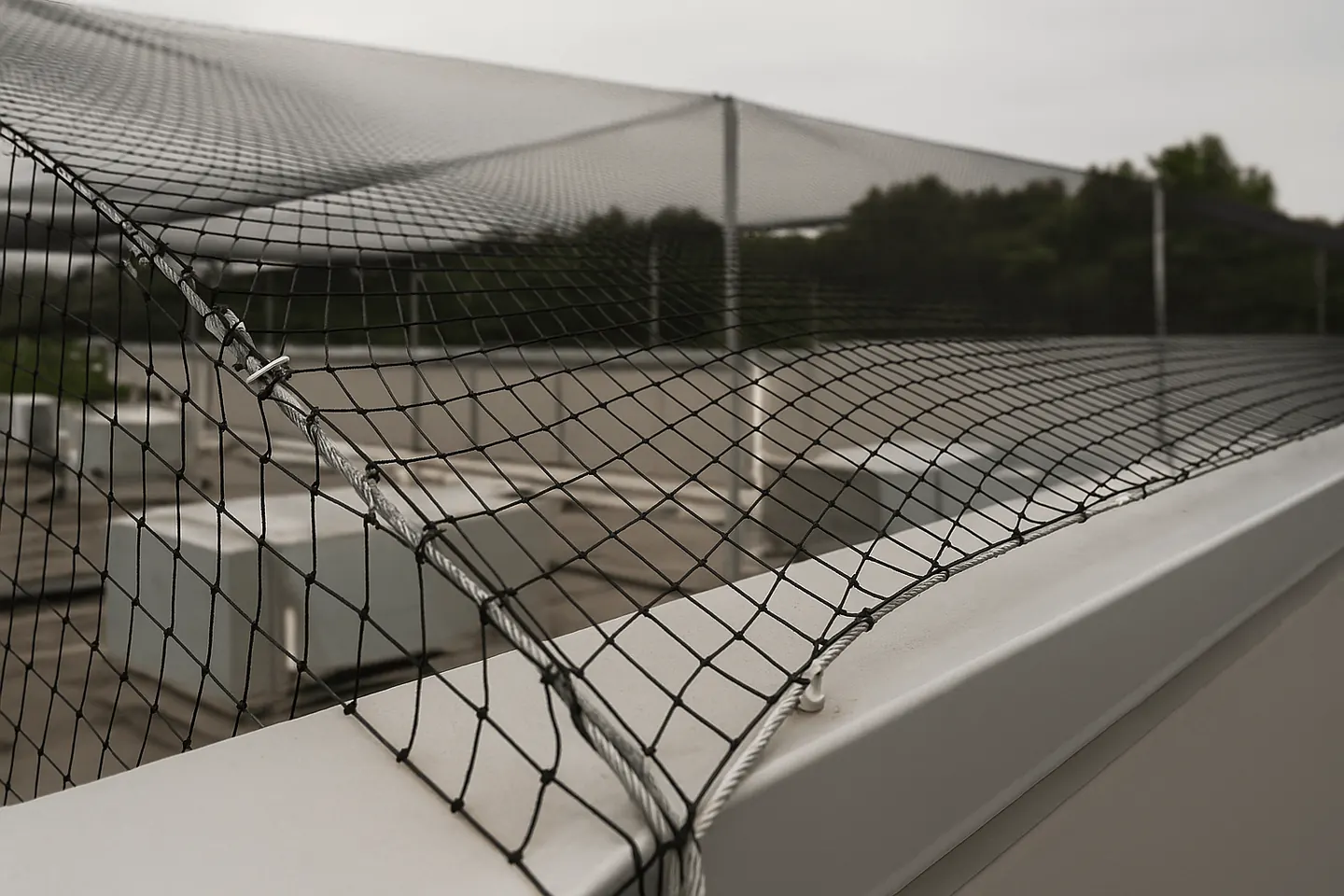
Bird netting closes off a whole space rather than a single ledge. It is the right product where birds nest or roost in numbers inside a structure: under a canopy or loading bay roof, in a courtyard or light well, on a balcony, behind a parapet, among roof plant or beneath solar panels.
We survey the area, work out where the net must run so no gap is left, and fit a tensioned system: a stainless steel wire perimeter on fixings suited to the structure, with the mesh laced to it and zips or panels where you need access. Mesh size is chosen for the species, smaller for starlings and sparrows, larger for pigeons and gulls.
Netting is used on warehouses, retail parks, hospitals, schools, car parks, apartment blocks and houses with pigeons under solar panels. Wild birds are protected, so nests in use are left until they are empty or, for feral pigeons, a general licence allows the work.
Pigeons and starlings look for sheltered, elevated structures with many perches: canopy steelwork, courtyard ledges, roof plant and the voids beneath solar panels. Spikes on one beam move them to the next; netting takes the whole space away.
An excluded colony tries every edge. A net that stops short of the wall or sags at a corner will be found, which is why the perimeter and the tension matter more than the mesh itself.
Unlike boarding or sheeting, a mesh keeps ventilation and daylight in a canopy or courtyard while keeping birds out, in black, stone or translucent to suit the building.
All wild birds, their nests and eggs are protected under the Wildlife and Countryside Act 1981. Excluding birds from a structure is the lawful approach and where the general licences expect any control to start.
A flock roosting on canopy steel, in a light well or on roof plant every night.
Nests on beams, ledges and ducting and under solar panels rather than on a single sill.
Droppings across a loading bay floor, a car park deck, stock, vehicles or balconies.
Constant calling and a sour ammonia smell inside the structure, which residents and staff notice first.
Birds nesting on top of or between spike strips, a sign the site has gone from perching to nesting pressure.
We identify the species, measure the structure, decide the mesh size, map where the perimeter wire runs, and check for active nests and for access from a tower, a platform or the structure itself.
Nests out of use are removed with the fouling around them, the area is damped down and cleaned and the waste bagged, so the net goes onto a clean structure.
Corner and intermediate fixings go into the steel, concrete or masonry, the perimeter wire is strained tight, and the mesh is laced to it so there is no slack edge or gap at the wall.
We fit zips or panels where you need access for maintenance, check every edge, tidy up and show you how to spot a problem with the net later.
Tell VermiCure what you have noticed and ask about the next step.
